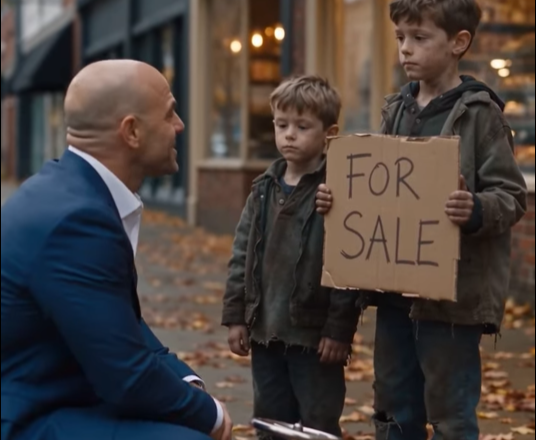
The man couldn’t answer.
Not immediately.
His hand remained on the tiny brass plate.
E.M.R.
Emily Marie Reed.
His daughter.
His only child.
The little girl who used to race that pedal car down their driveway while yelling,
“Faster, Daddy!”
The man closed his eyes.
Thirty years disappeared in a second.
When he opened them again, the two boys were watching him carefully.
The younger one moved closer to his brother.
The older boy asked,
“Are you really her dad?”
The man swallowed.
“Yes.”
Neither child smiled.
That hurt more than he expected.
The older boy’s expression hardened.
“Then why didn’t you help her?”
The question landed cleanly.
The man looked at him.
“I didn’t know she needed help.”
“She said you didn’t want her.”
His face changed.
“What?”
The boy looked suspicious now.
“Mom said she tried.”
“Tried what?”
“To come home.”
The man slowly stood.
“No.”
The older boy flinched.
He immediately softened his voice.
“No. I’m not saying you’re lying.”
He crouched again.
“I’m saying she never came to me.”
The boy studied him.
“She wrote letters.”
The man felt something cold move through him.
“What letters?”
“A lot.”
The younger boy finally spoke.
“She keeps them.”
The man turned toward him.
“Where?”
“In the blue box.”
The older boy nudged his brother gently.
But it was too late.
The man whispered,
“What blue box?”
Their mother had carried the same dented metal box through every apartment they had ever lived in.
Whenever the boys asked what was inside, Emily said only,
“Things I couldn’t throw away.”
Letters.
Returned envelopes.
Old photographs.
And one picture of a man standing beside a homemade red pedal car.
The man in the blue suit.
Much younger.
Smiling.
The older boy looked at him.
“She said every letter came back.”
The man’s eyes filled.
“That isn’t possible.”
“Why?”
“Because I’ve lived at the same house for thirty-four years.”
The boys exchanged a glance.
The man’s breathing slowed.
There had been only one person living in that house with him when Emily disappeared.
His wife.
Emily’s stepmother.
The woman who repeatedly told him,
“Stop chasing her. She made her choice.”
The woman who claimed Emily had called once and said never to contact her again.
His wife had died four years earlier.
Until this moment, he had never questioned the story.
The older boy noticed his expression.
“What?”
The man looked away.
“I think someone made both of us believe something that wasn’t true.”
The boy didn’t understand.
But he understood pain.
He had seen enough of it on his mother’s face.
The man asked,
“Where is Emily now?”
The older boy pointed toward the bakery.
“She works there.”
The man looked through the warm glass window.
Behind the counter, a woman was tying a paper bag for a customer.
Dark hair pulled back.
Tired face.
Simple apron.
Older than the daughter in his memories.
But unmistakably—
Emily.
His knees nearly weakened.
She smiled politely at the customer.
Then glanced toward the window.
Her smile vanished.
The paper bag slipped from her hand.
The man didn’t move.
Neither did she.
Thirty years stood between them.
Emily slowly came around the counter.
The bakery door opened.
The bell above it rang.
She stepped onto the sidewalk.
Her eyes moved first to her sons.
Then to the little red pedal car.
Then finally to him.
“Dad?”
His face collapsed.
“Emily.”
She took one step backward.
The older boy immediately moved beside her.
“We didn’t know.”
Emily looked down.
“What did you do?”
“We were selling the car.”
Her eyes widened.
“You what?”
The younger boy whispered,
“For the bus.”
Emily covered her mouth.
“I told you not to worry about that.”
“You were crying.”
That silenced her.
The man stood several feet away.
He wanted to hug her.
He didn’t.
Instead he said,
“I never got your letters.”
Emily stared at him.
“Please don’t.”
“Emily—”
“I can’t do this.”
She turned toward the bakery.
“Your letters came back?”
She stopped.
His voice trembled.
“All of them?”
Emily looked over her shoulder.
“Every one.”
“I never returned a single letter.”
She faced him.
Her expression became guarded.
“Then who did?”
The man couldn’t bring himself to say the answer yet.
“I don’t know.”
Emily laughed bitterly.
“You always said that.”
“What?”
“That you didn’t know.”
She stepped toward him now.
“You didn’t know why I left.”
“You didn’t know where I went.”
“You didn’t know I was pregnant.”
His eyes widened.
Emily looked toward her sons.
“Yes.”
The older boy took his little brother’s hand.
Emily continued.
“I was nineteen.”
“I was terrified.”
“And I came home.”
The man stared at her.
“What?”
“I came back.”
She pointed down the street as though the old house were still there.
“Three weeks after I left.”
His face emptied.
“No.”
“I stood on the porch.”
“I knocked.”
“Your car was in the driveway.”
His breathing became shallow.
“Who answered?”
Emily’s eyes filled.
“Linda.”
His late wife.
Emily’s stepmother.
The man closed his eyes.
Emily continued.
“She told me you knew I was pregnant.”
“She said you were ashamed.”
“She said you wanted me gone before your business partners found out.”
The man shook his head.
“No.”
“She gave me five hundred dollars.”
“No.”
“And told me never to come back.”
“Emily, no.”
His voice broke.
“I was looking for you.”
She stopped.
He pulled out his phone with shaking hands.
An old photograph still lived in a folder he had transferred from device to device for years.
A missing-person flyer.
Emily at nineteen.
Her old photograph beneath bold lettering.
He had printed thousands.
Hired investigators.
Called hospitals.
Checked shelters.
For nearly a decade.
Emily stared at the screen.
Her anger began to fracture.
“She told me you never looked.”
The man wiped his eyes.
“She told me you called.”
Emily frowned.
“What?”
“Two years after you disappeared.”
His voice shook.
“Linda said you called while I was at work.”
“She said you were happy.”
“Married.”
“Living somewhere out west.”
“And that you wanted me to stop looking.”
Emily stared at him.
“I never called.”
They stood in silence.
A dead woman’s lie finally collapsed between them.
Not one lie.
Dozens.
Enough to steal thirty years.
Emily looked away first.
“I don’t know what I’m supposed to do with this.”
“Nothing.”
Her father’s answer surprised her.
He stepped backward slightly.
“You don’t owe me anything tonight.”
She looked at him.
“I missed your whole life.”
His voice broke.
“I missed theirs.”
The boys stood beside the little car.
He looked at them.
“I don’t get to walk up and call myself Grandpa because we share blood.”
The older boy’s expression softened.
The man continued.
“But if you’ll let me…”
He looked back at Emily.
“…I’d like to stop missing things.”
She started crying.
Quietly.
The same crying her sons heard through the apartment wall every night.
Her father saw it.
And understood something.
“Emily…”
She wiped her face.
“What?”
“You said you need two hundred dollars for a bus.”
She nodded.
“We were coming tomorrow.”
“To find me?”
“Yes.”
The man looked at the red pedal car.
Then almost laughed through his tears.
“So they found me first.”
The older boy finally smiled.
“Does that mean you’re buying the car?”
The man looked at him.
“Absolutely not.”
The boy’s smile disappeared.
Then the man knelt beside the pedal car.
“This car isn’t for sale.”
He touched the chipped red paint.
“I built it for your mother.”
Then he looked at both boys.
“And if she says it’s yours…”
Emily nodded through tears.
“It is.”
The man smiled.
“…then it stays in the family.”
The younger boy touched the steering wheel.
The older one slowly lowered the cardboard sign.
Emily looked at her father.
“We still can’t stay where we’re living.”
His expression grew serious.
“I can help.”
She immediately stiffened.
“I don’t want your money.”
“Then don’t take it.”
She frowned.
He continued.
“Take dinner.”
“One conversation.”
“Maybe another tomorrow.”
“No conditions.”
“No fixing thirty years in one afternoon.”
Emily stared at him.
“And after that?”
He smiled sadly.
“You decide.”
Her sons looked up at her.
Emily took a long breath.
Then glanced toward the bakery.
“My shift ends at six.”
Her father checked his watch.
“I can wait.”
She studied him.
Thirty years earlier, she had stood on a porch waiting for her father to choose her.
He never knew she was there.
Now he stood on a sidewalk asking for nothing except a chance to remain.
Emily nodded.
“Six fifteen.”
His eyes filled.
“I’ll be here.”
She turned toward the bakery.
Then stopped.
“Dad?”
He looked up.
Emily pointed toward the pedal car.
“You painted that star terribly.”
The man stared at the crooked white star near the wheel.
Then laughed.
For the first time in thirty years, Emily laughed too.
Her sons looked between them.
And the older boy quietly tore the FOR SALE sign in half.
Because the little red car had never been worth two hundred dollars.
It had been carrying their family home all along.