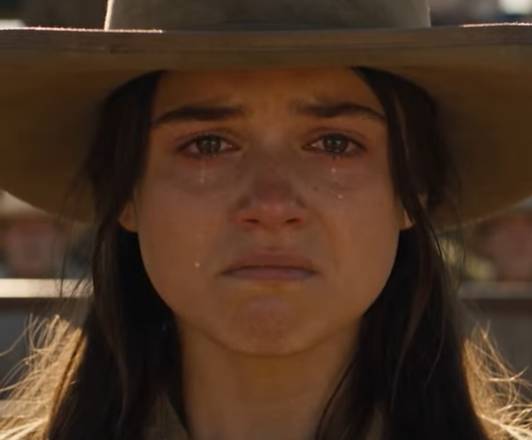
The young woman slowly looked toward the bleachers.
The elderly woman remained standing with one hand pressed against her heart.
Neither moved.
The guitarist kept playing.
Softly now.
Almost afraid to stop.
The man beside the microphone looked between them.
“You knew her mother?”
The older woman descended one wooden step.
Then another.
Her eyes never left the young woman.
“I knew that song.”
The young woman’s face tightened.
Her mother had sung it every night when she was little.
Never in public.
Never all the way through.
Just the first verse while brushing her daughter’s hair or washing dishes in their tiny kitchen.
Then one night, years earlier, Clara disappeared.
There had been a storm.
An overturned truck outside town.
Confusion.
People searching fields and roads until sunrise.
Clara was found alive, but badly shaken.
Afterward, she stopped singing completely.
And so did her daughter.
Not because anyone told her to.
Because every time she tried, she heard her mother’s voice breaking beside her.
Years later, Clara died without ever explaining why that particular melody frightened her.
The young woman had carried the silence ever since.
The elderly woman reached the bottom of the bleachers.
The guitarist stopped.
For the first time, the entire rodeo arena was completely silent.
The young woman looked at the guitarist.
“Why do you know it?”
He lowered his eyes.
The older woman answered.
“Because I wrote it.”
The young woman stared at her.
The older woman’s voice trembled.
“For my daughter.”
The man in the red shirt slowly turned toward her.
The young woman stopped breathing.
“Your daughter?”
The older woman nodded.
“Clara.”
A murmur moved through the bleachers.
The young woman’s face collapsed.
Her mother had always said she had no family.
No parents.
No one waiting for her.
But the woman standing in the dirt was crying like she had spent a lifetime doing exactly that.
The young woman whispered,
“She told me her mother died.”
The older woman closed her eyes.
“I was told Clara died.”
Silence again.
Two women.
Two different funerals that never happened.
Two lives built around the same lie.
The older guitarist slowly stood.
He looked at the young woman.
“Your mother used to sing here.”
The man in red looked toward him.
“Here?”
The guitarist nodded.
Before Clara disappeared, she had performed at this rodeo every summer.
She was seventeen.
Fearless.
Her mother sat in the first row every time.
Then one night Clara vanished after the show.
A family argument had already torn everything apart.
By morning, the older woman was told her daughter had run away and wanted no contact.
Clara, meanwhile, was told her mother had refused to take her back.
Neither knew both stories had been invented by the same relative who controlled the family land and wanted Clara gone.
Years passed.
Pride hardened into grief.
Grief hardened into silence.
Then Clara had a daughter.
She taught her the one song she remembered from home.
But never told her where it came from.
The young woman looked down.
“So she remembered you.”
The older woman began crying harder.
“She remembered the song.”
That was enough.
The man who had started all of this as a joke lowered the microphone.
His face was full of shame now.
“I didn’t know.”
The young woman looked at him.
Neither anger nor forgiveness.
Just exhaustion.
Then she turned back toward the elderly woman.
“Why are you here today?”
The woman reached inside her coat and removed an old folded rodeo program.
A faded photograph was printed inside.
A teenage Clara stood at this exact microphone.
Same eyes.
Same hat tilted slightly to one side.
And beside her—
the older guitarist.
The young woman covered her mouth.
The elderly woman whispered,
“I come every year.”
“Why?”
Her answer barely carried across the dirt.
“Because she told me once that if she ever found her way home, she’d sing this song first.”
The young woman broke.
For years, she thought her mother stopped singing because she wanted to forget.
Now she understood.
Clara had stopped because she could never finish the song without remembering the mother she believed had rejected her.
The guitarist sat back down.
He began the melody again.
The young woman looked at the microphone.
Then at the elderly woman.
Her hands were still shaking.
Her voice might fail.
She might not reach every note.
But this time she opened her mouth.
The first sound was small.
Rough.
Barely more than breath.
Then came the melody.
The elderly woman covered her face and sobbed.
Because the voice was different.
Younger.
Fragile.
But the song was Clara’s.
And after all those years, it had finally come home.