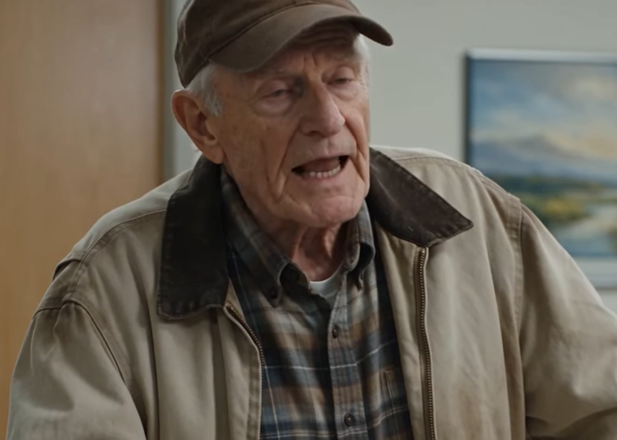
The doctor followed his father’s gaze.
The mother immediately looked down.
Her son was curled against her, exhausted.
The older man asked,
“How long have they been waiting?”
The receptionist went silent.
The mother hesitated.
“Almost four hours.”
Michael’s face changed.
“Four?”
She nodded.
“I kept asking.”
The receptionist rushed to explain.
“We were busy.”
The older man looked around.
The waiting room was crowded.
An elderly woman sat with a blanket around her shoulders.
A construction worker held a swollen hand against his chest.
A young mother rocked a crying baby.
None of them looked angry anymore.
Only tired.
The older man removed his cap.
“That’s why I’m here.”
Michael frowned.
“You said you came to see the new equipment.”
“I did.”
His father looked through the glass toward machines worth millions.
“But equipment doesn’t tell me whether the hospital is working.”
He turned toward the waiting room.
“People do.”
The receptionist stared at him.
The older man had deliberately arrived without a driver.
Without assistants.
Without announcing his name.
He had spent the morning walking through the hospital like an ordinary visitor.
He sat in the cafeteria.
Asked for directions.
Waited in hallways.
Watched.
Most employees treated him kindly.
A janitor offered him coffee when he looked tired.
A nurse walked him halfway across the building instead of merely pointing.
Then he reached reception.
And everything changed.
Michael rubbed his forehead.
“Dad, you could’ve told me you were coming.”
“That would’ve ruined the point.”
The receptionist whispered,
“Sir, I’m sorry.”
The older man looked at her.
“Would you be sorry if he hadn’t called me Dad?”
She had no answer.
His voice never rose.
“That’s what worries me.”
The mother nearby shifted nervously.
Her little boy coughed.
The older man turned immediately.
“Has someone assessed him?”
The mother shook her head.
“I was told to keep waiting.”
Michael stepped forward.
“I’ll get someone now.”
But his father caught his arm gently.
“No.”
Michael stared at him.
“No?”
“Not because I’m standing here.”
He pointed toward the waiting room.
“Fix the system that made four hours seem normal.”
Michael looked around.
For the first time that day, not as chief doctor.
As the son of the man who had spent decades building businesses and then quietly pouring much of that money into this hospital.
The new machines.
The pediatric wing.
The emergency renovation.
All of it existed because his father believed people without money deserved the same care as people with it.
Michael turned toward the receptionist.
“Why wasn’t the child reassessed?”
She looked down.
“He didn’t have an appointment.”
The older man’s expression changed.
“He’s in a hospital waiting room.”
Silence.
Michael immediately called for a nurse.
Within moments, the boy was being properly evaluated.
No dramatic promises.
No instant diagnosis.
Just attention that should have come earlier.
The older man sat beside the mother while they waited.
She looked at his worn jacket.
Then at the doctor.
“You really own this hospital?”
He smiled faintly.
“No.”
She looked confused.
He nodded toward the patients.
“A hospital belongs to the people who need it.”
Michael heard him.
So did the receptionist.
A few minutes later, Michael returned.
“The boy’s stable. They’re taking care of him.”
The mother’s shoulders dropped with relief.
“Thank you.”
The old man shook his head.
“You shouldn’t have needed me here for that.”
Then he turned toward his son.
Michael knew that look.
“What?”
His father glanced toward the expensive new wing.
“I donated twenty million dollars for those machines.”
Michael nodded slowly.
His father pointed toward the reception desk.
“But I think we spent money on the wrong problem first.”
The receptionist lowered her eyes.
Michael asked quietly,
“What do you want me to do?”
His father looked around the waiting room.
“Tomorrow, I want every board member sitting in these chairs.”
Michael blinked.
“No private entrance.”
His father put his cap back on.
“No names.”
“No titles.”
“No special treatment.”
The receptionist finally looked up.
The older man met her eyes.
“And nobody loses their job today because they embarrassed me.”
She looked surprised.
He continued,
“But tomorrow, we’re going to find out whether this was one bad moment…”
His eyes moved across the tired patients.
“…or the way people are treated when everyone assumes they don’t matter.”
Michael nodded.
His father started toward the exit.
Then the receptionist called after him.
“Mr. Carter?”
He stopped.
Her eyes were wet.
“I really am sorry.”
The older man studied her for a moment.
Then nodded toward the waiting room.
“Good.”
He opened the door.
“Now make sure the next person never needs to know my name to be treated like a human being.”