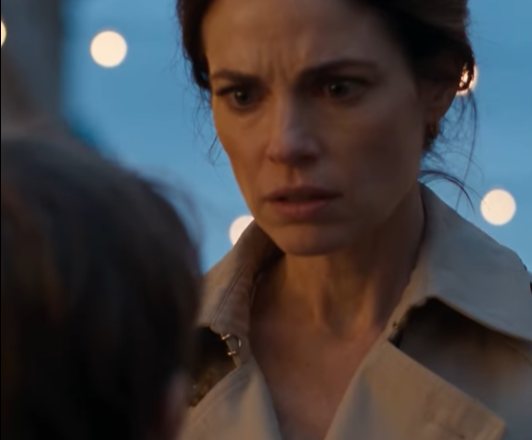
The boy pulled out a folded photograph.
Its edges were soft from being handled too many times.
The woman took it.
And nearly dropped it.
Two teenage girls stood beneath a tree.
One wore a white dress.
The other wore blue.
Both had golden leaf pins fastened near their collars.
The woman touched the photograph.
“That’s me.”
The boy nodded.
“My mom said you might not believe me.”
The woman looked at him.
“What is her name?”
“Rachel.”
Her knees weakened.
Rachel.
Her little sister.
The girl who vanished after an argument with their father when she was seventeen.
The family had searched for months.
Then their father claimed Rachel had contacted him.
He said she was safe.
That she wanted no contact.
That everyone needed to let her go.
The woman had spent nearly two decades believing her sister had chosen to disappear.
She looked at the boy again.
“Where is she?”
His face changed.
“In a shelter.”
The woman’s heart dropped.
“Why?”
The boy lowered his eyes.
They had been moving from place to place for months.
Rachel had lost her job.
Then their room.
Then most of what they owned.
She had tried to find her sister before.
Letters came back.
Old addresses led nowhere.
Eventually, she stopped believing she would ever reach her.
Until a week earlier.
They passed a charity poster on a city wall.
There was a photograph of the woman standing beside the mayor.
And pinned beneath her coat—
the golden leaf.
Rachel stopped walking.
She stared at the picture for almost a minute.
Then she removed her own pin and put it into her son’s hand.
“If you ever see her,” she told him, “show her this.”
The woman closed her eyes.
“Why didn’t she come herself?”
The boy’s voice cracked.
“She was scared.”
“Of me?”
He shook his head.
“Of being told you didn’t want her.”
The woman covered her mouth.
The lie had lasted nineteen years.
Her father had not received a message from Rachel.
He had sent one.
A cruel one.
Written in his older daughter’s name.
Telling Rachel never to come back.
Rachel believed her sister hated her.
The woman believed Rachel had abandoned them.
Neither had known they were grieving the same separation.
The boy pointed toward the photograph.
“There’s writing on the back.”
She turned it over.
Rachel’s handwriting.
If she still has the other pin, tell her I never threw mine away.
The woman started crying.
The boy watched nervously.
“I’m sorry.”
She shook her head.
“No.”
She crouched so they were eye level.
“You found me.”
The boy looked down.
“Mom said you might be angry.”
“At her?”
He nodded.
The woman closed both hands around the photograph.
“I’ve been waiting nineteen years to be angry at the right person.”
The boy didn’t understand.
She did.
Their father had died five years earlier.
He had taken the truth with him.
Or thought he had.
The woman looked again at the photograph.
There was something else.
A date.
And beneath it, a short note in their father’s handwriting.
She recognized it immediately.
Keep Rachel away until she signs.
Her tears stopped.
The boy noticed.
“What?”
The woman stared at the words.
“Signs what?”
That was the question.
Rachel had been seventeen when she disappeared.
Their mother had died only months earlier.
There had been an inheritance.
A trust.
Documents the woman was told Rachel had willingly surrendered.
Suddenly, the timing looked very different.
Her sister had not simply been forced out of the family.
Someone had needed her gone.
The woman stood.
“Take me to your mother.”
The boy looked startled.
“Now?”
“Now.”
He hesitated.
“She looks different.”
The woman’s face softened.
“So do I.”
“She might cry.”
“So will I.”
He finally nodded.
They started walking beneath the amber street lights.
After a few steps, the boy looked up.
“Are you really her sister?”
The woman touched the pin at her collar.
Then looked at the matching one still resting in his palm.
“Yes.”
The boy gave the smallest smile.
“Then she was right.”
“About what?”
“She said you’d still be wearing it.”
The woman stopped.
Nineteen years.
Different cities.
Different lives.
One lie between them.
And yet both sisters had carried the same tiny golden leaf all that time.
Not because they believed they would find each other.
But because some part of each of them had never stopped hoping.