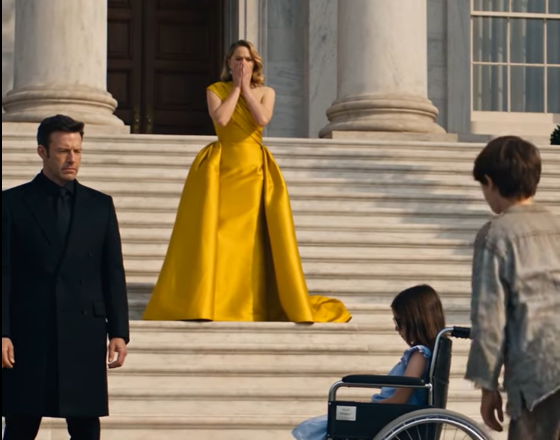
The man stared at his daughter’s hand.
She had reached toward him perfectly.
Not searching.
Not guessing.
Toward him.
His wife saw it too.
Her composure cracked.
The father crouched beside the stroller.
He didn’t remove the sunglasses.
He only whispered,
“Can you see me?”
The girl’s lips trembled.
For several seconds, she said nothing.
Then tears slipped beneath the dark lenses.
“Sometimes.”
The word destroyed him.
He looked toward his wife.
For two years, specialists had been told his daughter’s vision was deteriorating.
Appointments had been canceled.
Reports had been summarized for him instead of shown directly.
He traveled constantly for work.
His wife handled everything.
Every consultation.
Every morning routine.
Every explanation.
And every time he asked why their daughter seemed to react to light, movement, or faces, he was told hope was making him imagine things.
The boy stood beside the burlap sack.
He had worked occasionally around the estate with his mother.
He noticed the girl watching birds when nobody else was near.
Following shadows.
Turning toward objects before they made sound.
Then one morning he saw the woman in yellow give her something from the brown bottle.
Afterward, the girl became frightened and disoriented.
He didn’t know what it was.
He only knew something didn’t fit.
So he saved the discarded packaging and label.
The father looked down at the paper again.
It wasn’t proof of some elaborate medical conspiracy.
But it was enough to reveal that his wife had been giving their daughter something he had never been told about.
And the label carried instructions from a clinic he didn’t recognize.
He stood slowly.
“Why?”
His wife shook her head.
“I was protecting her.”
The little girl flinched at her mother’s voice.
That reaction answered more than the words.
The father looked back at his daughter.
“From what?”
His wife’s eyes filled.
“From leaving.”
He stared at her.
Then understood.
The marriage had been collapsing for years.
Custody had been discussed privately.
And the girl’s condition had made everything simple.
She depended almost entirely on her mother.
The mansion had been modified around her.
Travel seemed impossible.
School happened at home.
Every decision revolved around keeping mother and daughter together.
The little girl gripped the stroller blanket.
Her voice was tiny.
“She told me Daddy wouldn’t want me if I got better.”
The man’s face collapsed.
His wife covered her mouth.
He crouched in front of his daughter again.
This time, his own hands were shaking.
He held them out where she could choose whether to reach.
She did.
Immediately.
He wrapped his fingers around hers.
“I would want you if you could see everything.”
She started crying.
“I would want you if you could see nothing.”
The woman in yellow stepped backward.
The boy said nothing.
He had already done what he came to do.
The father looked at the sunglasses.
Then at his daughter.
“You don’t have to prove anything right now.”
The girl slowly removed them herself.
Bright daylight touched her face.
She squinted.
Blinking hard.
Her eyes struggled to adjust.
But then they found him.
Not perfectly.
Not instantly.
Enough.
Her father saw the recognition.
So did her mother.
The girl stared at his face as though she had been waiting years to look at him without pretending she couldn’t.
Then she whispered,
“You look different than I imagined.”
And the man finally understood that the worst thing stolen from his daughter wasn’t her sight.
It was the belief that she was allowed to use it.