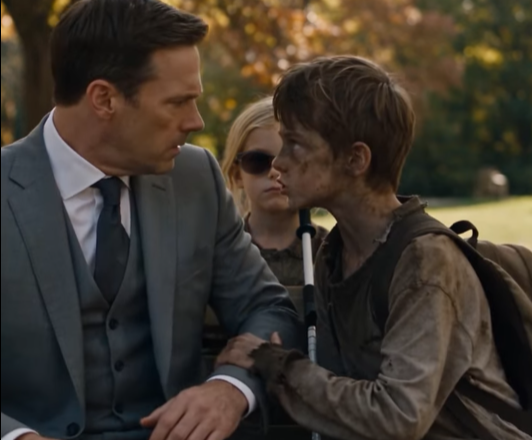
“Emma.”
Her father’s voice shook.
The faint smile disappeared.
She lowered her head.
He removed his hand from the bench as though afraid even the smallest movement might frighten her.
“Sweetheart…”
A long silence.
Then she whispered,
“Don’t tell her.”
His heart sank.
“Tell who?”
Emma’s fingers tightened around the white cane.
“Mom.”
The boy beside them looked down.
The man stared at his daughter.
His wife was not Emma’s biological mother.
She had married him three years earlier, shortly after Emma began experiencing severe vision problems following an illness.
Doctors had warned that recovery was uncertain.
Some days Emma responded to light.
Other days she seemed completely unable to see.
Then, over time, everyone believed the remaining vision had disappeared.
Everyone except Emma.
Her father crouched beside the wheelchair.
“You can see?”
Emma’s lips trembled.
“A little.”
He covered his mouth.
“How long?”
“Months.”
The answer nearly knocked him backward.
“Why didn’t you tell me?”
Her face crumpled.
“Because every time it got better, she got angry.”
The autumn park seemed to go completely silent around them.
The father whispered,
“What do you mean?”
Emma looked toward the boy.
He gave her a tiny nod.
Permission.
Courage.
She continued.
“At first I could only see shapes.”
Her father listened without moving.
“Then colors.”
Her voice became softer.
“Then your face.”
His eyes filled immediately.
“You saw me?”
Emma nodded.
“The morning you wore the red tie.”
He remembered that morning.
He had knelt beside her chair before work.
Asked if she liked his new tie.
She had smiled and said,
“I wish I could see it.”
He had kissed her forehead.
Now he realized she had been looking directly at him.
He began crying.
“Why did you pretend?”
Emma removed her sunglasses.
Her eyes were tired.
Sensitive.
But focused.
She looked directly into her father’s face.
“Because she told me if you knew I was getting better, I’d have to leave.”
His expression changed.
“Leave?”
“She said you’d send me away.”
“No.”
He shook his head immediately.
“Never.”
Emma’s breathing grew uneven.
“She said you only kept me because you felt sorry for me.”
The man closed his eyes.
His wife had spent months convincing his daughter that recovery would cost her the only parent she had left.
He looked toward the boy.
“How do you know about the food?”
The boy reached for his battered backpack.
“I sleep behind the houses near your street sometimes.”
The father looked at his worn clothes.
He understood without needing more explanation.
The boy continued.
“Your kitchen window faces the alley.”
One night, while looking for somewhere dry during the rain, he saw the wife standing alone in the kitchen.
Emma’s dinner was on the counter.
The woman added something from a small bottle.
Nothing dramatic.
Nothing obvious.
Then stirred it in.
The next evening, the boy saw her do it again.
He didn’t know what it was.
But he noticed something else.
Whenever Emma ate those meals, she became unusually tired.
Confused.
Sometimes she barely lifted her head.
But one afternoon, Emma’s plate was knocked onto the floor before she ate.
That evening—
she walked toward the window.
And looked directly outside.
Straight at the boy.
He froze.
Emma froze too.
Neither said anything.
The next day, he saw her again.
Without the dark glasses.
Watching birds from her bedroom window.
That was when he understood.
She could see.
At least partly.
And somebody inside the house did not want anyone to know.
The father turned back toward Emma.
“Did the food make your vision worse?”
She hesitated.
“I don’t know.”
Good.
No certainty.
Only fear.
She explained that some evenings she felt overwhelmingly sleepy and disoriented after dinner.
Other days, when she ate very little or skipped the meal entirely, her head felt clearer.
Her sight seemed stronger.
But she never knew whether the two things were connected.
Her father’s hands trembled.
“Why didn’t you tell a doctor?”
Emma looked terrified.
“She comes to every appointment.”
That sentence broke something inside him.
He stood.
Not furious.
Not shouting.
Focused.
“We’re not going home yet.”
Emma looked scared.
“Dad?”
“We’re getting you checked by someone she doesn’t know.”
He crouched again.
“And whatever happens, you stay with me.”
Emma stared into his eyes.
“You promise?”
“With everything I have.”
The boy started gathering his backpack.
The father stopped him.
“Wait.”
The boy froze.
The man looked at him.
“What’s your name?”
“Leo.”
“Leo… thank you.”
The boy shrugged awkwardly.
“She looked scared.”
As if that explained everything.
Maybe it did.
The father reached for his phone.
Emma suddenly grabbed his wrist.
“Dad.”
He stopped.
“What?”
Her eyes moved toward the park entrance.
The color vanished from her face.
Her father followed her gaze.
A woman in an elegant coat was walking toward them.
His wife.
She smiled when she saw them.
Then noticed Emma’s sunglasses were off.
Her steps slowed.
The father remembered the boy’s words.
Watch her eyes when she lies.
His wife approached.
“What are you doing here?”
The father said nothing.
She looked at Emma.
Then at Leo.
Her smile tightened.
“Who is this?”
Leo remained silent.
The father watched her carefully.
“Emma says she can see.”
For one fraction of a second—
his wife’s eyes changed.
Not surprise.
Recognition.
Then she smiled.
“That’s wonderful.”
The father felt cold.
Because now he had seen it too.
She already knew.
Emma’s hand reached blindly toward him out of habit.
Then stopped.
She looked directly at her stepmother.
And for the first time, she didn’t pretend.
“I saw you.”
The woman’s smile vanished.
Emma’s voice trembled.
“In the kitchen.”
Her father looked at his wife.
“What was in her food?”
The woman stepped backward.
“Nothing.”
Leo whispered,
“She looked away.”
The father noticed.
His wife’s eyes had broken contact immediately.
Exactly as the boy predicted.
He took Emma’s hand.
“We’re leaving.”
His wife reached toward the wheelchair.
“No, wait—”
Emma recoiled.
That was enough.
The father positioned himself between them.
No threats.
No violence.
Only certainty.
“You’ll have every opportunity to explain this.”
His wife stared at him.
“But not to her.”
Then he turned toward Leo.
The boy had already started walking away.
“Leo.”
The boy stopped.
The father looked at Emma.
She was staring at Leo clearly now.
No sunglasses.
No pretending.
Emma raised one hand.
“Thank you.”
Leo smiled.
Small.
Tired.
Then Emma added,
“You were right.”
Her father looked down.
“About what?”
Emma kept her eyes on the boy.
“The first day he saw me through the window…”
She swallowed.
“I wasn’t scared because he knew I could see.”
Her father waited.
Emma finally whispered,
“I was scared because he was the first person who realized I was pretending.”
For months, every adult had watched her blindness.
A boy nobody noticed had watched her fear.
And that was how the truth finally came into focus.