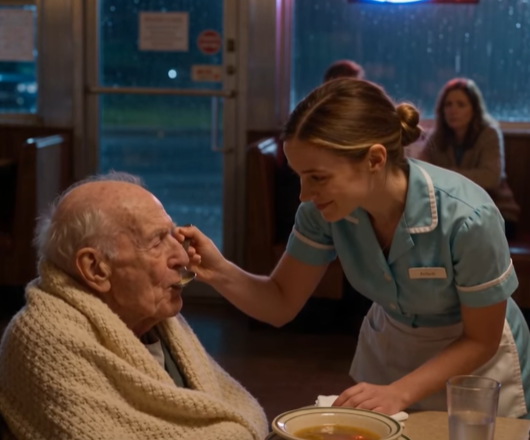
The rain filled the silence.
The drenched man stood staring at the wheelchair.
At the blanket.
At the thin face he had spent fourteen years trying to forget.
His father.
Alive.
The waitress stepped back slowly.
The elderly man’s lips moved, but his voice barely came out.
“I’m sorry.”
His son laughed once.
Not because anything was funny.
Because sometimes pain has nowhere else to go.
“Sorry?”
Water dripped from his sleeves onto the diner floor.
“You disappeared.”
The old man lowered his eyes.
“We found your car in the river.”
His son’s voice began to shake.
“Your wallet was inside.”
The couple in the booth said nothing.
The waitress remained beside the wheelchair, one hand resting protectively on its handle.
The son stared at her.
“How long has he been here?”
She hesitated.
“Almost a year.”
That answer seemed to hurt him physically.
“A year?”
The old man closed his eyes.
His son took another step closer.
“You were twenty miles from me.”
The waitress looked down.
She had never known much about the man she fed every night.
He called himself Arthur.
He had arrived one winter evening with an old duffel bag and no phone.
He never begged.
Never explained.
He simply sat in the same booth until closing.
Then one night, his legs gave out near the door.
After that, she started bringing him food.
Eventually, a local charity found him the wheelchair.
But whenever she asked about family, Arthur changed the subject.
Now she understood why.
His son knelt slowly in front of him.
“Why?”
Arthur’s eyes filled.
For a long time, he couldn’t answer.
Then he looked toward the waitress.
And she saw shame there.
Not fear.
Shame.
“I owed people money,” he whispered.
His son stared at him.
“A lot of money.”
Arthur swallowed.
“They were threatening the house. Your mother. You.”
The son’s anger weakened slightly.
Arthur continued.
“I thought if everyone believed I was dead, the insurance would protect you.”
The son’s face hardened again.
“That’s fraud.”
Arthur nodded.
“I know.”
“And you let Mom mourn you.”
Arthur’s eyes closed.
A tear ran down his cheek.
“She died believing you were dead.”
That sentence destroyed him.
Arthur’s chin dropped toward his chest.
The waitress covered her mouth.
The son stood abruptly and turned away.
He pressed both hands against his face.
Outside, thunder rolled again.
Nobody spoke.
Then Arthur whispered,
“I went to the funeral.”
His son slowly turned.
Arthur was crying openly now.
“I stood across the road.”
The son stared at him.
“You watched us bury an empty coffin?”
Arthur nodded.
His voice broke.
“I watched you hold your mother while she collapsed.”
The son looked like he had been struck.
For several seconds, the only sound was rain.
Then the waitress noticed something strange.
Arthur was reaching beneath his blanket.
His hand emerged holding a small plastic envelope, yellowed from age.
Inside was a photograph.
He handed it to his son.
The man stared down.
It showed him at sixteen, standing beside his father outside a small garage.
On the back was handwriting.
One sentence.
If I ever become brave enough, I’ll come home.
The son’s hands started shaking.
“Why didn’t you?”
Arthur looked at the wheelchair.
Then at his weak hands.
“I kept thinking I had one more year.”
His voice faded.
“One more year to fix what I’d done before you saw me.”
He looked around the diner.
“But years don’t wait for shame.”
The son crouched again.
His anger was still there.
So was the betrayal.
But beneath both of them was something older.
A child who had spent fourteen years missing his father.
Arthur looked at him carefully.
“I don’t expect forgiveness.”
His son’s jaw trembled.
“Good.”
Arthur nodded.
Then his son reached forward.
Not for a hug.
Not yet.
He simply pulled the blanket higher around his father’s shoulders.
The same small gesture the waitress had made minutes earlier.
Arthur started crying harder.
The waitress turned away to give them privacy.
And as rain continued pouring beyond the red OPEN sign, the son finally understood why his father had looked so familiar when he walked in.
Not because he remembered his face.
Because even after fourteen years, he remembered exactly how it felt to lose him.