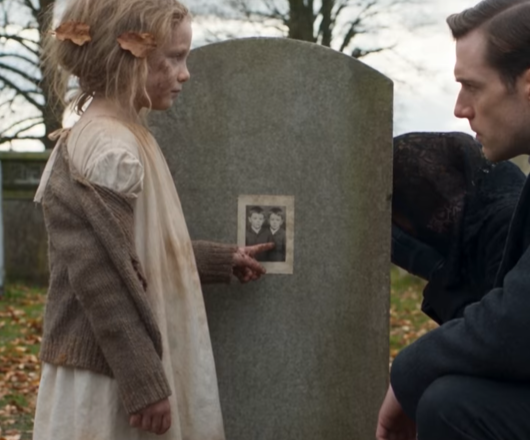
The father stood up so fast he slipped slightly in the mud.
The mother was already crying harder, not with mourning now, but with the terror of hope.
“Take us there,” the father whispered.
The little girl nodded and turned without another word.
They followed her through the graveyard, past wet stones and fallen leaves, out to the road beyond the cemetery. She walked barefoot the whole way, small and silent, while the couple stumbled after her like their lives had already started changing and they were afraid to believe it.
The orphanage on the East side was old and tired, with peeling paint and dim windows.
Inside, the air smelled like dust, soap, and boiled soup.
The girl led them down a narrow hallway.
“The last room,” she said.
The father’s shaking hand pushed the door open.
Two boys sat on a narrow bed under a weak grey light.
Older now.
Thinner.
Paler.
But unmistakable.
The mother let out a cry so raw it silenced the whole building.
Both boys looked up at once.
For one frozen second, nobody moved.
Then the smaller boy stood up so quickly his chair tipped backward.
“Mommy?”
The mother dropped to her knees before she even reached them, pulling both boys into her arms, sobbing into their hair, their shoulders, their little shaking hands.
The father followed, falling beside them, crying openly now.
“My sons… my boys…”
The taller one stared at him, lips trembling.
“We thought nobody wanted us.”
That line broke him completely.
He held both boys against his chest while the mother kissed their faces over and over like she was trying to make up for every missing night.
Then the father looked up at the orphanage matron standing in the doorway.
Her face had gone pale.
“Who brought them here?” he asked.
The matron lowered her eyes.
For a moment, she couldn’t speak.
Then she whispered, “Your brother.”
The father went still.
The boys clung tighter to their mother.
“He came the night of the fire,” the matron said, voice shaking. “He told us the boys had no family left. He paid us to keep them off the records.”
The mother covered her mouth, horrified.
The father’s face hardened with a new kind of pain.
Not grief.
Betrayal.
The little barefoot girl was still standing in the hallway, watching quietly.
The smaller boy looked at her and whispered, “She told us our parents were still crying for us.”
The mother turned to the girl through tears.
The child gave the smallest shrug.
“You were.”
And in that dim orphanage room, after months of mourning children who had never been dead, two parents finally understood the truth that hurt even more than loss—
their sons had not been taken by death.
They had been hidden.